
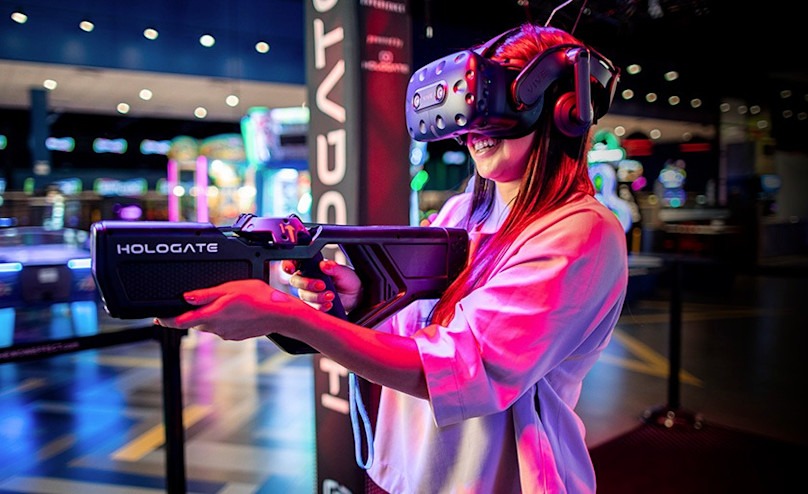
VR gaming experiences have officially crossed the threshold from a niche technological novelty to a transformative medium that challenges our very perception of reality. I still vividly remember the first time I strapped on a high-end headset and found myself standing on the edge of a virtual skyscraper. My logical mind knew I was standing on a flat carpet in my living room, but my lizard brain was screaming in terror as I looked down at the street below. This profound sense of “presence” is the holy grail of interactive entertainment, and it is what sets virtual reality apart from every other form of media we have ever created.
When we talk about immersion in a traditional sense, we usually mean getting lost in a good book or being captivated by a cinematic masterpiece on a large screen. However, virtual reality takes that concept and amplifies it by removing the barrier of the “frame.” In a VR environment, you are not just an observer; you are a participant in a 360-degree world that responds to your physical movements. If you want to see what is behind you, you don’t nudge a thumbstick; you physically turn your body. This 1:1 mapping of physical action to digital reaction is what makes the experience feel so visceral and personal.
The journey to this point has been long and fraught with technical hurdles that once seemed insurmountable. In the early nineties, initial attempts at consumer VR were plagued by low-resolution displays and sluggish tracking that left users more nauseated than amazed. We simply didn’t have the processing power or the display technology to fool the human eye. Fast forward to today, and we are seeing a golden age of development. With the advent of high-resolution OLED panels and sophisticated inside-out tracking, the dream of stepping into another world is finally a reality for millions of households.
Why VR gaming experiences feel so incredibly real
The secret sauce that makes virtual reality so effective is a combination of visual fidelity, spatial audio, and haptic feedback. Visuals are the most obvious component, where high refresh rates of 90Hz or 120Hz are essential to prevent motion sickness. When the world moves as fast as your eyes do, the brain begins to accept the digital environment as “real.” But visuals alone aren’t enough to sustain the illusion. You need spatial audio to tell your ears where a sound is coming from in a three-dimensional space, whether it is the rustle of leaves behind you or the distant roar of an engine.
Haptic feedback is the third pillar that completes the sensory loop. Modern VR controllers use advanced actuators to mimic the feeling of different textures and resistances. When you pull the trigger of a virtual bow, the tension you feel in the controller makes your brain believe you are actually drawing an arrow. Some high-end haptic vests even allow you to feel the impact of a gust of wind or the recoil of a weapon on your chest. These sensory layers work together to create a “cognitive bypass” where you stop thinking about the technology and start living in the moment.
I remember playing a survival game where I had to scavenge for supplies in a dark, abandoned hallway. The spatial audio was so precise that I could hear the skittering of something small in the vents above me. My heart rate spiked, and my palms started to sweat. In a traditional game, I would have felt a mild sense of tension. In VR, I felt a genuine sense of primal dread. That is the power of the medium. It doesn’t just entertain you; it provokes a physiological response that stays with you long after you have taken the headset off.
The evolution of hardware in VR gaming experiences
The landscape of hardware has shifted dramatically over the last few years, moving away from tethered systems toward standalone freedom. For a long time, the best VR gaming experiences required a powerful gaming PC and a thick bundle of cables that often acted as a tripping hazard. This limited the reach of the technology to hardcore enthusiasts with the space and budget to support it. The release of the Meta Quest series changed the game by putting all the processing power directly into the headset, allowing users to play anywhere without being tied to a desk.
This move toward portability has democratized the medium, but it hasn’t killed the high-end market. PCVR remains the destination for those seeking the absolute peak of visual performance. Games like Half-Life: Alyx demonstrate what is possible when you have the raw power of a high-end graphics card pushing every pixel. The level of detail in these environments—the way light refracts through a glass bottle or the subtle animations of a character’s face—creates a level of realism that standalone hardware simply cannot match yet. It is a spectrum of choice that allows every gamer to find their preferred entry point.
Sony has also made significant strides with its PlayStation VR2, bringing high-end features like eye-tracking and foveated rendering to the console space. Eye-tracking is a particularly fascinating development. The headset knows exactly where you are looking, allowing the system to focus its resources on rendering that specific area in high detail while blurring the periphery. This mimics how the human eye works and allows for much more complex visuals without requiring a supercomputer. It also opens up new gameplay mechanics, such as selecting menu items or aiming weapons just by looking at them.
The social aspect of virtual reality is perhaps the most surprising element for many newcomers. While gaming is often seen as a solitary activity, VR gaming experiences are incredibly social. Platforms like VRChat or Rec Room allow people from all over the world to hang out in virtual spaces that feel much more intimate than a standard chat room. When you see a friend’s avatar move their hands and head in real-time, your brain interprets it as a real physical presence. You aren’t just talking to a screen; you are standing next to a person, even if they are thousands of miles away.
I have spent evenings sitting around a virtual campfire with friends, playing card games and just talking. Despite our avatars being stylized or even cartoonish, the sense of togetherness was undeniable. This “social presence” has profound implications for the future of communication. It allows for a level of empathy and connection that is often lost in text or video calls. In VR, you can share a space, an activity, and a memory in a way that feels tangible. It is the evolution of the internet from a place we look at to a place we inhabit.
One of the most exciting frontiers is the intersection of virtual reality and physical fitness. Many people find traditional gyms boring, but VR turns a workout into a game. Titles like Beat Saber or Supernatural have transformed the way people view exercise. Instead of counting reps, you are slicing through neon blocks to the rhythm of your favorite music or dodging obstacles in a high-speed obstacle course. You are moving your entire body, burning hundreds of calories, and you are having so much fun that you barely notice the physical exertion until the headset comes off and you are drenched in sweat.
The variety of genres available is also expanding at a rapid pace. While shooters and rhythm games were the early staples, we are now seeing deep role-playing games, complex flight simulators, and even narrative-driven “walking simulators” that focus on storytelling. Horror remains one of the most popular genres because the immersion makes every jump scare feel personal. On the other hand, puzzle games benefit from the ability to physically manipulate objects in a three-dimensional space, allowing for “escape room” style challenges that would be impossible on a flat screen.
However, the path to a perfect virtual world isn’t without its challenges. Motion sickness remains a hurdle for a significant portion of the population. This occurs when there is a “vestibular mismatch”—your eyes see movement, but your inner ear tells your brain that you are sitting still. Developers have come up with clever solutions, such as “comfort vignettes” that narrow the field of view during movement or teleportation-based locomotion. Over time, many players develop their “VR legs,” becoming accustomed to the sensation, but it remains a barrier for universal adoption.
Space requirements are another practical consideration. To get the most out of room-scale VR gaming experiences, you need a dedicated area free of furniture and pets. Not everyone has a spare room they can turn into a holodeck. This is why stationary or seated experiences are so important. Being able to play a high-quality flight sim or a racing game from the comfort of a chair ensures that the technology remains accessible to those living in smaller apartments. It is about flexibility and meeting the player where they are.
The cost of entry, while falling, is still a factor for many families. While standalone headsets are relatively affordable, the price of a high-end PC or a console plus the headset can still be a major investment. We are waiting for that “killer app” moment where the value proposition becomes undeniable for the average consumer. We have had glimpses of it with titles like Resident Evil or Astro Bot, but the industry still needs a consistent stream of AAA content to move from a “cool toy” to an essential piece of household technology.
Looking toward the future, the boundaries between virtual reality and augmented reality are beginning to blur into what we call “Mixed Reality” or “Spatial Computing.” The newest headsets feature high-quality cameras that allow you to see the real world around you with digital objects overlaid on top. Imagine playing a board game where the characters are standing on your real kitchen table, or a shooter where enemies are coming through your actual living room walls. This blend of the real and the digital creates a whole new category of interactive experiences that feel even more integrated into our lives.
The role of artificial intelligence in these worlds is also a major point of interest. AI-driven characters in VR will soon be able to hold natural conversations with players, responding to their voice and gestures in real-time. This will move us away from rigid “dialogue trees” toward a world where NPCs (non-player characters) feel like living, breathing parts of the environment. Imagine walking into a virtual tavern and having a genuine, unscripted conversation with a barkeep about the local lore. This level of dynamic interaction will be the next major leap in immersion.
As we move forward, the “Trustworthiness” of these platforms will become increasingly important. With headsets capable of tracking our eye movements, heart rates, and even the layout of our homes, data privacy is a significant concern. The companies that lead this industry must be transparent about how this data is used and ensure that users feel safe in these virtual spaces. Building a world where people can be their authentic selves requires a foundation of security and respect for the individual’s digital rights.
I often think about where this technology will be in twenty years. Will we be wearing lightweight glasses that are indistinguishable from normal eyewear? Will we have haptic suits that allow us to feel the temperature of a virtual sun or the spray of a digital ocean? The trajectory suggests that we are heading toward a future where the distinction between “online” and “offline” becomes increasingly irrelevant. We are building the architecture of a new reality, one where the only limit is our collective imagination.
For anyone who hasn’t tried a modern headset, my advice is simple: find a way to experience it. No amount of text or 2D video can truly convey the feeling of being inside a virtual world. It is a “seeing is believing” technology that has to be felt to be understood. Whether you are flying a starship through a nebula, fighting off a horde of zombies, or just sitting on a virtual beach watching a digital sunset, the sense of wonder is universal. It reminds us that technology, at its best, is a tool for expansion and exploration.
The impact of VR gaming experiences on our culture is just beginning to be felt. It is changing how we learn, how we work, and how we play. It is providing a canvas for artists to create works that were previously physically impossible. Most importantly, it is giving us a way to escape the limitations of our physical world and explore the infinite possibilities of the digital one. It is a journey that is just getting started, and I, for one, can’t wait to see where the next headset takes us.
The emotional resonance of these games is something that shouldn’t be overlooked. I have seen people moved to tears by a beautiful narrative in VR, or overwhelmed with joy by a simple interaction with a virtual creature. Because the experience is so direct and unfiltered, the emotional impact is amplified. It is a powerful reminder of our capacity for empathy and our desire for connection. In the end, virtual reality is not about the hardware or the pixels; it is about the human experience and the stories we tell each other in the dark.
As you explore the various titles and platforms available today, remember to take it slow and find what works for you. There is no right or wrong way to enjoy VR. Some people want high-octane action, while others want a quiet space for meditation. The beauty of the medium is its versatility. It is a mirror that reflects our diverse interests and desires. So, step into the light, put on your headset, and get ready to see the world—and yourself—in a whole new way.
We are standing at the edge of a new era of human expression. The tools we are building today will be the foundation for how the next generation interacts with the world. By embracing the potential of virtual reality, we are opening doors to experiences that were once the stuff of dreams. It is a bold, exciting, and occasionally terrifying frontier, but it is one that is well worth exploring. The future of gaming is not just on a screen; it is all around us.
Read also :-
| young18gye |
| miofragia |
| qapoxerfemoz |
