
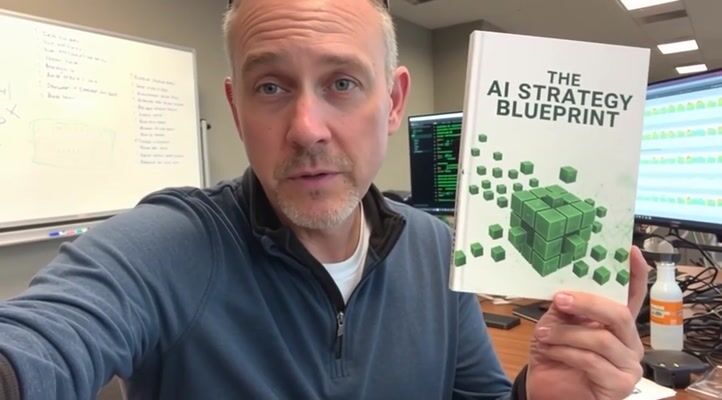
A review of The AI Strategy Blueprint’s testing advice for systems that can take actions across a workflow.
This review was prepared for a paid placement. The book link leads to Iternal Technologies, the author’s company.
A team demonstrates an AI agent that reads a request, drafts a response, and prepares a task in a shared work queue. In its demonstration, the three steps happen in the right order. A more interesting test begins when the queue is unavailable, a person edits the request halfway through, or a draft has already been prepared. The system’s value depends on what happens in those cases as much as what happens when the path is clear.
John Byron Hanby IV devotes part of the reliability section of The AI Strategy Blueprint to the particular challenges of testing agentic AI. The book distinguishes successful completion from respect for boundaries, examines the effects of sequences of actions, and calls for a tested way to halt activity. That is a strong foundation. It becomes more actionable when a team describes which state changes are expected, who can observe them, and what should be recoverable.
Describe the allowed result before running the test
Begin with a small set of outcomes the agent is authorized to produce. In the example, the desired outcome might be one draft attached to the correct internal request and a task assigned for human review. The agent may be allowed to collect source material and prepare the draft. The person reviewing it can decide whether it should become a message or trigger further action. Those decisions should be legible in the design and in the record of what happened.
A team can evaluate the end state alongside the words returned by the system. Did the item reach the right queue? Did it receive the right number of follow-up tasks? Was a person able to review a proposed change before it was applied? A conversational response saying that a task is complete can be useful to the user, but it is not the most direct evidence that the workflow ended correctly.
Hanby emphasizes testing entire sequences rather than isolated actions. A draft can be accurate while the surrounding process creates more work. Two individually appropriate operations may combine badly when the source changes between them. Repeated execution can also create duplicate tasks if a person is unsure whether the first attempt succeeded. Tests should account for the state that was left over from earlier runs.
Make delays and interruptions part of the scenario
In a test environment with synthetic work records, interrupt the workflow while a request is being prepared. Check which actions already occurred and which can still be authorized. Then let the operator inspect the record without relying on the agent’s summary. If the same request is resumed, confirm what the person needs to decide before another action can be taken.
The book’s emphasis on an emergency stop is valuable. Stopping a run and recovering from it have different requirements. An operator needs to know which changes were already applied and what remains in the queue. There must be a plan for restoring or correcting affected records where possible. Setting these expectations before launch makes an interruption easier to manage even if the software never leaves its permitted scope.
The team can also test behavior on ordinary uncertainty. A request that lacks a required detail may need to be returned to a person. A proposed operation may be possible technically while falling outside what the organization authorized. A well-designed workflow makes it easy for someone to check whether the agent paused at the right point and what it asked the operator to do.
Give operators an exception queue they can actually use
A workflow can stop correctly on an uncertain case and still fail the people operating it. Imagine an exception queue that shows only that a task needs attention. The reviewer has to inspect the original request, identify which sources the system used, and find out whether any action already occurred. If several alerts look alike, the operator may have trouble identifying which one requires judgment.
Test the handoff with the person who will receive the exception. Ask whether the record shows what is waiting, what has already been done, and what decision is needed. The operator should be able to act within the role the organization assigned to them. A test can also ask whether the queue remains manageable when several requests arrive together.
This is an important extension of the book’s discussion of human oversight. The cost of review depends on the information available to the reviewer and the time they have to use it. While a tool is in trial, gather examples of confusing handoffs and measure how long people take to resolve them. The finding can improve the operating design before a bigger deployment turns those delays into a routine expense.
Treat changing behavior as an operating condition
Hanby describes functional, performance, reliability, safety and security, and ethical evaluation as separate categories. The book also argues for repeated testing with representative work. Those suggestions fit a system whose behavior can vary across inputs or versions. A release record can capture what was tested, what a successful run looks like, and which cases require a person’s decision. Repeat the most consequential cases when instructions, tools, or the environment change.
A good performance metric may also need a quality counterpart. Fast completion is useful, but reducing the time to create a task does little if employees must reconcile duplicates or correct assignments afterward. Track how often the agent sends work for review, how frequently people reverse its decisions, and which cases consume the most human time. Those observations can improve both the workflow and the testing set.
The book suggests that automation can increase as evidence accumulates. That is a helpful principle where the change is reversible and the organization can support it. Some actions should continue to require human authorization even when the system performs well on representative cases. The decision about authority belongs with the people accountable for the process.
The chapter is most useful when read by the people who will have to operate the system, including the person who can pause it. The test of an agent is visible in the records it leaves and in the actions a person can review, halt, or correct. Those are the conditions under which a polished demonstration can become a dependable working process.

1 comment
Scrolling back through the Business archive caught
Scrolling back through the Business archive caught my eye – the piece on reaching support was more useful than I expected, since a lot of it is about knowing which number to call first. Similar how-to write-ups for the other categories would be welcome…
Comments are closed.